

Safety in Relationships After Trauma

This blog explores how past attachment dynamics and relational trauma can influence our perceived sense of safety and, thus, our behavior in new relationships.

The scene is set: you have escaped a past toxic relationship filled with turmoil and pain, and your current partner - who by all intents and purposes is kind, generous, thoughtful, funny, and personable - does a kind, generous, and thoughtful thing for you . . . and you get the ick. Or, you look back on the last month and realize that you and your partner have fallen into a consistent schedule of work, cooking dinner together, watching a show, going to bed, and doing the same exact routine the next day, leading you to potentially feel a level of discomfort about the monotony and mundaneness. You may think - “this is boring! Should it feel more exciting? Where’s the tension? Do they even love me anymore? Is there no spark? This doesn’t feel as deep or passionate as my last partner, even though they were responsible for my relational trauma! Maybe I need to start an argument in order to feel that way again!” You might then internalize these thoughts or reactions immediately as proof that your relationship is flawed or doomed.
These thoughts are not bad, concerning, or even unusual, but they’re alerting you to something more important and foundational underneath the surface: because of past experiences, your body is mistaking anxiety for passion, connection with chaos, and intensity with intimacy. This is a learned nervous system response often following significant interpersonal or relational trauma, either as children or in adulthood. We might have learned through repeated experiences that in order to receive ‘love’ or ‘safety’ in relationships, or for them to feel passionate and exciting, we have to tolerate or allow disrespectful, inconsistent, or abusive behavior. We become accustomed to this type of dynamic. We expect it. When it doesn’t happen in a new relationship that feels healthier and stabilizing, we can inadvertently sabotage the new dynamic to unconsciously recreate what we’ve experienced in the past, because it’s familiar. This blog post will go more in depth on how early attachment dynamics as well as possible relational trauma influence our perception of safety and, thus, regulation and calmness, in adult relationships.
Before exploring this more deeply below, please remember: this blog gives insight as to why we might experience these thoughts/behaviors and how our nervous system has tried its very best to adapt to difficult life experiences. This does not mean you are at fault, to blame, or should be ashamed if any part of this resonates with you. You were doing the best you could with the resources and information you had to stay safe at the time.
Attachment Concepts:
If you have participated in therapy before, it’s highly likely that you have learned a little bit about attachment theory in childhood development before. If not, have no fear! In order to recognize how our nervous systems react in present day relationships, we need to gain insight on the way our caregivers responded to us and treated us in childhood. Here are a few main components that might help you understand attachment and how it shapes our perceptions of relationships in adulthood a little better (if you’d like a more comprehensive overview of attachment styles and examples, click here to read a fellow clinician’s blog post!):
The foundation of attachment theory lies in the work of psychologists John Bowlby & Mary Ainsworth, who explored how the bond we form as infants and young children with our caregivers influences our level of perceived security in all other relationships over the course of our lives
Attachment behaviors are primal and the urge to nurture, protect, and care for vulnerable infants allowed for increased survival in the early and more dangerous times for humans.
There are four generally recognized ‘attachment styles’ that have unique traits and are shaped by the type of care and treatment we received early in life. Read below to learn about them.
Secure attachment → formed when our caregivers attune to our needs, respond consistently, and are emotionally and physically available to be nurturing; this enhances our confidence to explore the world independently and provides a strong foundation of healthy levels of intimacy and trust in adult relationships. The monotonous, mundane, or boring phases of adult relationships make us feel safe and secure.
Anxious attachment → our caregivers responded to us and our needs inconsistently (sometimes they nurtured us, and sometimes they didn’t), leading to us not knowing if we will be protected or comforted; this lends to increased hypervigilance in adult relationships, constant reassurance seeking, and insecurities related to being abandoned or unloved. Monotonous, mundane, or boring phases of adult relationships trigger anxiety, leading us to ruminate or hyper-fixate on what’s going ‘wrong’.
Avoidant attachment → our caregivers were emotionally unavailable, tending to our physical needs like feeding & bathing but didn’t offer emotional connection, closeness, or attunement; this leads to more withdrawn and self-reliant adults who appear uncomfortable with intimacy and shut down in close relationships. As adults, if we are treated with nurturing/connection/affection, we can inadvertently self-sabotage because our systems are not used to that consistently.
Disorganized attachment → infancy and childhood were marked by fear, confusion, or trauma due to potentially abusive and frightening caregiving; in adulthood, this can show up as fear of close relationships coinciding with high levels of anxiety and emotional dysregulation. We crave the nurturing and affection in adult relationships we didn’t receive as children, but become dysregulated when it occurs as it is unfamiliar. Monotony and ‘boring’ also brings fear because we were used to being in fight or flight mode as children.
Any kind of childhood trauma can impact attachment development and safety in our caregiving relationships, leading to specific attachment wounds
If you experienced repeated patterns of emotional inconsistency, lack of attunement to your needs, unpredictable moods, or even abuse or neglect by your caregivers - then you have experienced what is called relational trauma. Trauma - an emotional response to a physically or psychologically stressful event - directly impacts our sense of safety and stability in relationships. When relational trauma is experienced, we have to implement all kinds of tricks and systems in order to adapt to what no longer feels safe. This might mean you become hyper-vigilant to your parent’s moods and shove down your own emotions so as to not ‘rock the boat’ if they’re in a bad mood. It could look like shutting down the connection-seeking parts of you because you’ve been taught your needs will be rejected. Hyper-independence, emotional dysregulation, and frantic efforts to avoid abandonment are all potential strategies we use to adapt to past relational trauma. Remember, these are learned nervous system responses--when we become conditioned to something, the complete opposite is often what is feared. In this context, a nurturing, attuned, reliable, and consistent partner might feel unsafe to your body.
What if trauma is actually what feels familiar? And thus, safe?
If relational trauma is something you have become accustomed to over the course of your life, odds are your brain and body have learned to expect it. This doesn’t mean you deserved it, or that it should happen, but humans are remarkably adaptive creatures who form associations with past events.
Think of it like this - a child who is routinely bullied throughout elementary school by kids on the soccer team might form an association that travels with them throughout middle and high school where they expect to be mistreated or bullied by every person who plays soccer. While that might not be totally accurate, it is an example of our brain and body working very hard to protect us from any possible pain.
Now, this next statement might sound counterintuitive, but hear me out: when relational trauma is the consistent theme in our lives, it becomes a familiar pattern that we can predict. Our nervous systems can rely on it. This predictability can actually feel safe to us because it’s all we’ve known, and anything new or different brings fear. Let me say this again:
Familiar patterns, even if rooted in significant trauma, can feel safe because they are predictable to our nervous system.
This statement doesn’t mean we crave chaos or mistreatment just for the heck of it, but it’s what we know. Because it’s what we know, our nervous system has almost become conditioned to fear safety. In this blog post, safety is shown through slow, routine, and consistent behaviors coupled with affection and nurturing. When you have never had that, or were constantly shoving your own needs or emotions aside to ensure you never lost it, then it does not feel safe.
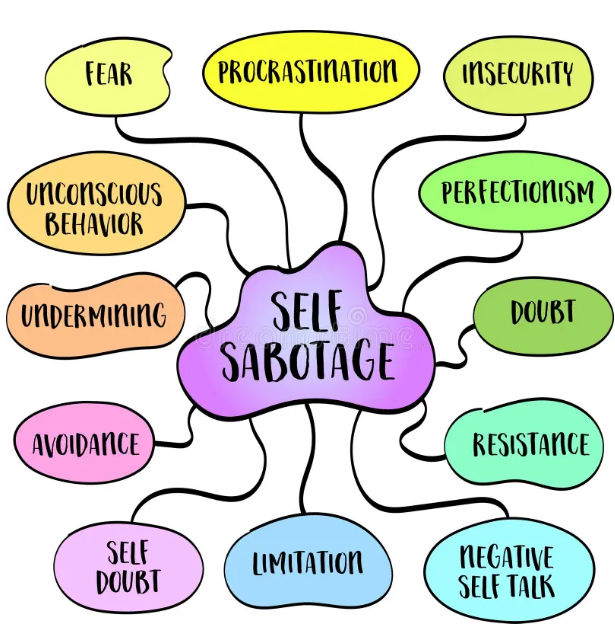
It is also important to normalize the idea of self-sabotage when we get into healthier and more stable adult relationships. We are going to reframe this from a negative trait that should be avoided to a very common trauma response! Self-sabotage really is just an unconscious discomfort with something new--in this case, something nurturing and connective--that can lead to us unintentionally recreating past chaos and dysregulation in order to get comfort from a feeling we used to find predictable. This unconscious pattern might show up first as the weight on your chest, the unsettled stomach, or the restlessness in your body which provides data that we are experiencing emotional discomfort. Remember, emotional discomfort (and thus, physical sensations) are not bad or something to fear - they are messengers that we need to look inward and ask ourselves what we need.
What you need might be:
To stop shaming this unconscious urge to recreate chaos in order to feel stability, and instead use the insight we have gained from the impact of childhood attachment/relational trauma to normalize your impulses.
To tune in to the felt sensation of your body and tend to your basic needs of slowing down to nourish yourself, hydrate, take a warm shower, and get adequate rest in order to provide your nervous system with care.
To directly and intentionally offer yourself true self-compassion for how you’ve behaved and felt in order to adapt to relationships, and trust that you and your body deserve a new experience of safety.
While this blog provided education, insight, and normalization of many common experiences, often different types of therapy can be beneficial in order for you to truly feel accepting of safer and more stabilizing relationships. Please reach out to our team to learn more about talk therapy, EMDR, or somatic-based approaches in order to help integrate what we have explored into healing!
Sources:
Cassey, A. (2025, May 20). How childhood trauma shapes adult attachment styles over time: Our guide. Psyche Central. https://psychecentral.org/how-childhood-trauma-shapes-adult-attachment-styles-over-time/
Ellison, Jillian. “Why Healthy Love Feels Boring after Surviving Chaos: Beneath the Surface Therapy.” Beneath the Surface Therapy, Beneath the Surface Therapy, 21 May 2025, www.beneaththesurfacetherapy.net/beneath-superficiality/why-healthy-love-feels-boring-after-surviving-chaos.
Sills, D. (2023, August 22). 10 common patterns seen in unresolved relational trauma. Psychology Today. https://www.psychologytoday.com/us/blog/understanding-ptsd/202308/10-common-patterns-seen-in-unresolved-relational-trauma?msockid=24c039a561f668cc34082d5d60b9694e


Hallo zusammen! Ich wollte mich kurz zu diesem wirklich wichtigen Thema äußern. Der Beitrag über die Bedeutung von sicheren Beziehungen nach traumatischen Erlebnissen ist mir besonders nahegegangen und hat mich wirklich zum Nachdenken gebracht. Ich stimme Ihnen da vollkommen zu, dass dies ein Aspekt ist, der oft unterschätzt wird. Manchmal vergisst man, wie tiefgreifend solche Erfahrungen sein können und wie sehr sie das Vertrauen in Beziehungen beeinflussen. Was mich besonders beeindruckt hat, ist, wie gut Sie dieses komplexe Thema aufbereitet haben. Man merkt wirklich die Mühe und die Tiefe, die Sie investiert haben. Der Einstieg war sehr gelungen und hat mich sofort gepackt. Aber wie Sie andeuten, geht das Thema "sichere Beziehungen" noch viel tiefer, und genau das habe ich…